
What is a Global Capability Center (GCC)? A Complete Guide for 2026

Texas Instruments made a quiet but consequential decision in 1985. It opened an R&D facility in Bengaluru — the world’s first Global Capability Center. Nobody called it that at the time. It was just an offshore unit. Four decades later, that single decision has become a template followed by over 1,800 multinational corporations operating out of India alone.
So what exactly is a Global Capability Center — and why does it matter to your career or your business in 2026?
This guide answers both questions in full.
Table of Contents
What Is a Global Capability Center (GCC)?
A Global Capability Center (GCC) — also called a Global In-House Center (GIC) or Captive Center — is an offshore or nearshore facility that is wholly owned and operated by a multinational corporation (MNC) to deliver strategic business functions for its global operations.
The key word is wholly owned. Unlike traditional outsourcing, where work is handed to a third-party vendor, a GCC is a direct extension of the parent company. The employees are on the parent company’s payroll. The intellectual property belongs entirely to the parent company. The strategic decisions made in the GCC influence global operations directly.
Think of it this way: when Goldman Sachs engineers in Bengaluru build the firm’s global risk modelling platform, they are not contractors working for a vendor — they are Goldman Sachs employees building Goldman Sachs products. That is the essence of a GCC.
According to the NASSCOM–Zinnov India GCC Landscape Report 2024, India hosts over 1,700 GCCs with more than 2,975 operational units, collectively employing 1.9 million professionals and generating $64.6 billion in revenue in FY2024. By 2030, the ecosystem is projected to grow to 2,100–2,200 GCC centers, a workforce of 2.5–2.8 million, and revenues of $99–105 billion.
What a GCC Is NOT — Clearing the Confusion
This is where most guides fail to help. Understanding what a GCC is not is just as important as knowing what it is.
A GCC is NOT a BPO. A Business Process Outsourcing (BPO) company is a third-party vendor that handles standardized tasks for multiple clients. A GCC works exclusively for one parent company and handles strategic, high-value functions — not commoditized processes.
A GCC is NOT an IT services company. TCS, Infosys, and Wipro are IT services firms — they bid for client projects, bill by time and resources, and work across many different clients simultaneously. A GCC has one “client”: its own parent company. This changes everything — the ownership, the culture, the career trajectory, and the pay.
A GCC is NOT a shared services center (necessarily). A Shared Services Center (SSC) centralizes repetitive back-office functions like payroll or finance. Modern GCCs go far beyond this — they own product development, AI strategy, R&D, and global decision-making. Many GCCs began as SSCs but have evolved well past that stage.
A GCC is NOT the same as offshoring. Offshoring simply means relocating work to another country. A GCC is a specific organizational structure — wholly owned, strategically integrated, and increasingly leading innovation for the parent company globally.
The History and Evolution of GCCs in India
Understanding the GCC’s evolution helps explain why it has become the most important employer model for India’s knowledge economy.
Phase 1.0 — The Back Office Era (1985–2005) Texas Instruments’ 1985 Bengaluru facility and Citibank’s Pune center marked the beginning. The primary driver was simple: India offered skilled English-speaking graduates at a fraction of Western labor costs. Work consisted of data entry, IT maintenance, customer support, and basic finance operations. Value was measured purely by cost savings.
Phase 2.0 — Digital Enablement (2005–2015) As India’s engineering ecosystem matured, GCCs began owning software development, analytics, and product engineering. Companies stopped treating their India operations as back offices and started investing in them as genuine capability centers. This phase saw the first GCC employees moving into global leadership roles.
Phase 3.0 — The Innovation Shift (2015–2022) GCCs began owning end-to-end global product lifecycles, building proprietary intellectual property, and contributing directly to parent company strategy. The NASSCOM–Zinnov report notes that over 44% of GCCs have transitioned into “Portfolio Hubs” — centers driving end-to-end ownership rather than just execution.
Phase 4.0 — The AI-Native Intelligence Era (2022–Present) This is where we are today. According to the EY GCC Pulse Survey 2025, 92% of GCC leaders affirm their centers now contribute far beyond cost arbitrage. 58% of GCCs are actively investing in Agentic AI, with another 29% planning to scale over the next year. 87% of GCCs now own end-to-end global processes, and 45% participate directly in global enterprise decision-making.
The GCC is no longer a satellite office. It is increasingly the intelligence core of the global enterprise.
Types of GCCs and Operating Models
GCCs are not one-size-fits-all. They vary significantly by function, maturity, and setup model.
By Function
Shared Service Centers (SSCs): Centralize finance, HR, legal, and administrative functions. High efficiency focus. Examples: Citi’s finance operations in Mumbai, Unilever’s HR center in Bengaluru.
Engineering Research & Development (ER&D) Centers: Own product design, embedded systems, and next-generation platform development. Examples: Bosch’s ER&D center in Bengaluru, Qualcomm’s chip design center in Hyderabad.
Technology / Product Engineering Centers: Full-stack software product development, cloud infrastructure, AI platforms. Examples: Google, Microsoft, SAP, Adobe.
Centers of Excellence (CoEs): Deep domain specialization in a single function — cybersecurity, data science, supply chain AI. Often embedded within larger GCCs.
By Setup Model
Captive Model: Fully owned and operated from day one. Maximum IP control, higher setup complexity and cost. Suited for large enterprises with clear long-term commitment.
Build-Operate-Transfer (BOT): A local partner builds and runs the center for 18–36 months, then transfers full ownership to the parent company. Reduces initial risk and speeds up launch time.
Company-Owned, Partner-Operated (COPO): Parent company retains IP and governance, but operational management is handled by a local partner. Balances control with operational flexibility.
By Maturity Stage
Greenfield GCC: Built from scratch in a new location. Maximum flexibility in culture and architecture but requires longer ramp-up (typically 12–18 months to full productivity).
Brownfield GCC: Built by acquiring or expanding an existing operation. Faster launch, but requires reconciling legacy processes and culture.
Mature / Bellwether GCC: Centers that have operated for 10+ years and now function as strategic co-equals of global headquarters — owning IP, setting global process standards, and producing leaders who hold global mandates.
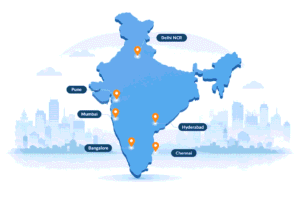
Top GCC Locations in India
Location choice is one of the most consequential decisions in GCC strategy. Each hub has distinct strengths.
Bengaluru: remains India’s GCC capital, hosting 34–39% of all GCC activity and nearly 900 GCC units. Its strength lies in deep product engineering, AI/ML, and SaaS talent. According to the EY GCC Pulse Survey 2025, 46% of survey respondents’ GCCs are concentrated in Bengaluru. In 2024 alone, Bengaluru generated 60,000+ new GCC jobs.
Hyderabad: hosts 20–23% of GCC activity, with particular strength in BFSI, pharma, healthcare, and data analytics. Home to major centers for companies like Google, Facebook, Amazon, and Apple. 42,000+ new GCC jobs created in 2024.
Pune: is the hub for ER&D and automotive engineering GCCs, with strong talent in embedded systems and manufacturing tech. 30,000+ new GCC jobs in 2024.
Chennai: leads in fintech, automotive R&D, and semiconductor design. 20,000+ new GCC jobs in 2024.
Gurugram / NCR: is strong for BFSI, consulting, and legal/compliance GCCs, particularly for US and European financial services firms.
Tier-2 Cities (Rising): According to the NASSCOM–Zinnov 2024 report, over 215+ GCC units are now housed in emerging locations including Ahmedabad, Coimbatore, Kochi, Jaipur, and Bhubaneswar. These cities offer 25–30% lower operational costs than Bengaluru with improving talent pipelines and strong state-level government support.
Most In-Demand Skills in GCCs
The EY GCC Pulse Survey 2025 identifies the priority hiring areas for GCCs heading into 2026. Talent acquisition is increasingly focused on niche capability over volume.
1. GenAI and LLM Engineering: The highest-demand, highest-premium skill category. GCCs need professionals who can build, fine-tune, and operationalise large language models for enterprise functions. Per EY, 83% of GCCs are currently scaling GenAI projects. Salary premium over standard software engineering: 30–40%.
2. AI/ML Engineering and MLOps: Beyond GenAI, broader machine learning expertise — model development, ML pipelines, data infrastructure — is a top hiring priority for 63% of GCCs, per the EY GCC Pulse Survey 2025.
3. Cloud Architecture and DevOps: Zero-trust cloud architecture, Kubernetes, Terraform, and multi-cloud governance are foundational for GCCs managing global infrastructure. Cited as a priority by 70% of GCCs in the EY survey.
4. Cybersecurity: Cybersecurity maturity is improving but gaps remain — only 7% of GCCs have a fully embedded cyber Center of Excellence (EY GCC Pulse Survey 2025). This gap is actively being filled through aggressive hiring. Zero-trust architecture specialists are among the highest-paid technical profiles.
5. Data Engineering and Business Intelligence: Business intelligence adoption in GCCs has risen to 86% (up from 80% the prior year), while data strategy has risen to 67% from 51% (EY GCC Pulse Survey 2025). Data engineers supporting these platforms are in sustained high demand.
6. Domain-Specialist Hybrid Roles: Professionals who combine domain depth (BFSI risk, healthcare compliance, supply chain) with technical fluency are particularly sought-after. 66% of GCCs cite domain expertise as a top hiring priority (EY GCC Pulse Survey 2025).
GCC Salary Benchmarks 2026
GCCs are leading India’s salary growth in 2026. According to the EY Future of Pay 2026 Report, GCCs are projected to deliver the highest salary increments in India at 10.4% — ahead of all other sectors including IT services (9.6%) and IT-enabled services (9.0%).
Attrition has also significantly improved. Per the EY GCC Pulse Survey 2025, GCC attrition fell from 13% in 2023 to 9% in 2025 — the lowest across major industry segments — reflecting growing employee satisfaction and retention investment.
Here are indicative salary ranges by experience level for Software Engineers in Bengaluru GCCs (adjusted by city using our GCC Pay Compass data):
| Experience | GCC (Bengaluru) | IT Services | Product/Startup |
|---|---|---|---|
| 0–2 years | ₹6–10 LPA | ₹4–7 LPA | ₹8–14 LPA |
| 3–5 years | ₹14–22 LPA | ₹9–15 LPA | ₹18–30 LPA |
| 6–9 years | ₹24–38 LPA | ₹16–26 LPA | ₹32–55 LPA |
| 10–14 years | ₹40–65 LPA | ₹28–45 LPA | ₹55–90 LPA |
Sources: NASSCOM, EY GCC Pulse Survey 2025, Zinnov, LinkedIn Salary Insights, AmbitionBox. Ranges are indicative. Use the GCC Pay Compass for role-specific, city-adjusted estimates.
Professionals with GenAI and LLM engineering skills command a 30–40% premium above the standard software engineering range. Leadership roles (Director and above) in mature GCCs regularly exceed ₹1 crore annually in total compensation, including ESOPs and RSUs — which 75% of GCCs now offer beyond the leadership level to retain critical contributors (EY Future of Pay 2026).
The Future: AI-Native GCCs and the Intelligence Shift
The GCC model is at a pivotal inflection point. The era of labor arbitrage is effectively over for mature centers — what is emerging is something far more strategically significant.
From cost center to intelligence hub. The EY GCC Pulse Survey 2025 reveals that 67% of GCCs are now creating dedicated innovation teams and incubation programs to generate, test, and globalize ideas from India. Budget allocations reflect this shift: 25% of GCC resources go into technology and transformation, and 23% toward talent development.
Agentic AI is the defining technology of 2026. With 58% of GCCs investing in Agentic AI and 83% scaling GenAI deployments, the nature of work inside GCCs is fundamentally changing. Routine processes are being automated. GCC professionals are moving from execution to orchestration — directing AI systems that handle the operational workload while humans focus on judgment, strategy, and innovation.
Leadership is moving to India. The Zinnov–NASSCOM 2024 report documents that over 6,500 global leadership roles have been established within Indian GCCs, including over 1,100 women in global positions. This is a decisive shift — India is not just providing talent, it is producing the leaders who make global decisions.
The challenge ahead. Despite this progress, nearly 80% of GCCs still have less than 10% of global leadership roles based in India (EY GCC Pulse Survey 2025). Leadership localisation — moving decision authority from HQ to the GCC — remains the unfinished chapter. The GCCs that solve this first will hold the strongest competitive position in the decade ahead.
The organizations that treat their GCCs as strategic co-equals — not offshore support arms — are already pulling ahead. For professionals and enterprises alike, the GCC is no longer a career option or a cost strategy. It is the primary arena for global knowledge work.
Should You Work at a GCC? A 5-Question Framework
This decision is highly personal. Use this framework to get clarity:
1. Do you want deep product ownership over client delivery? If yes → GCC is a better fit than IT services. GCC employees own outcomes; IT services employees execute deliverables.
2. Is global exposure and cross-cultural collaboration important to you? If yes → GCC is ideal. You work directly with global headquarters, often collaborating with colleagues across US, Europe, and Asia.
3. Do you value job stability over high-risk/high-reward upside? If yes → GCC beats early-stage startups. GCCs offer the stability of a large MNC with product-company-quality work.
4. Are you aiming for a leadership role in the next 5–7 years? If yes → GCCs offer the fastest growing leadership pipeline in India right now. Over 6,500 global roles established in Indian GCCs as of 2024.
5. Is compensation competitive with your current or target market rate? Use the GCC Pay Compass to check. If a GCC role you’re evaluating pays within 15% of a product company for your profile, the stability, ownership, and long-term incentives typically make the GCC the better overall package.
If you answered yes to 3 or more of these questions, a GCC career is strongly aligned with your goals.
Frequently Asked Questions
Q: What is the full form of GCC?
A: GCC stands for Global Capability Center. It is also referred to as a Global In-House Center (GIC) or Captive Center.
Q: What is the difference between a GCC and a BPO?
A: A BPO is a third-party vendor handling standardized work for multiple external clients. A GCC is wholly owned by one parent MNC, handles high-value strategic functions, and retains all intellectual property internally.
Q: Which Indian cities have the most GCCs?
A: Bengaluru leads with 34–39% of all GCC activity, followed by Hyderabad (20–23%), Pune, Chennai, and Gurugram. Tier-2 cities like Ahmedabad and Coimbatore are growing rapidly.
Q: Do GCCs pay more than IT service companies?
A: Yes, in most cases. GCCs project salary increments of 10.4% in 2026 versus 9.6% for IT services, and typically pay 20–35% more for equivalent roles at the mid-senior level (Source: EY Future of Pay 2026 Report).
Q: What skills are needed to get a job in a GCC?
A: The highest-demand skills are GenAI/LLM engineering, cloud architecture, cybersecurity, data engineering, and domain-specialist hybrid roles combining technical and domain expertise. Soft skills — particularly communication with global stakeholders — are consistently cited by GCC hiring managers as a key differentiator at the final stage.
Q: Is a GCC the same as an MNC?
A: Not exactly. An MNC (multinational corporation) is the parent company. A GCC is the MNC’s wholly owned offshore or nearshore subsidiary. When people say “I work at a GCC,” they mean they work at the India (or nearshore) unit of a global MNC.
Data sources: NASSCOM GCC Annual Report 2024, Zinnov–NASSCOM India GCC Landscape Report 2024, EY GCC Pulse Survey 2025, EY Future of Pay 2026 Report, Everest Group GCC Market Outlook 2026.
For role-specific, city-adjusted GCC salary estimates, use the free GCC Pay Compass →